
A summer storm rolls across Central Florida just after your irrigation cycle ends. You wasted the water you pumped, and the turf never needed it. Repeat that across 18 holes year after year, and you can see what guesswork really costs. Precision golf turf management uses real data instead of guesswork.
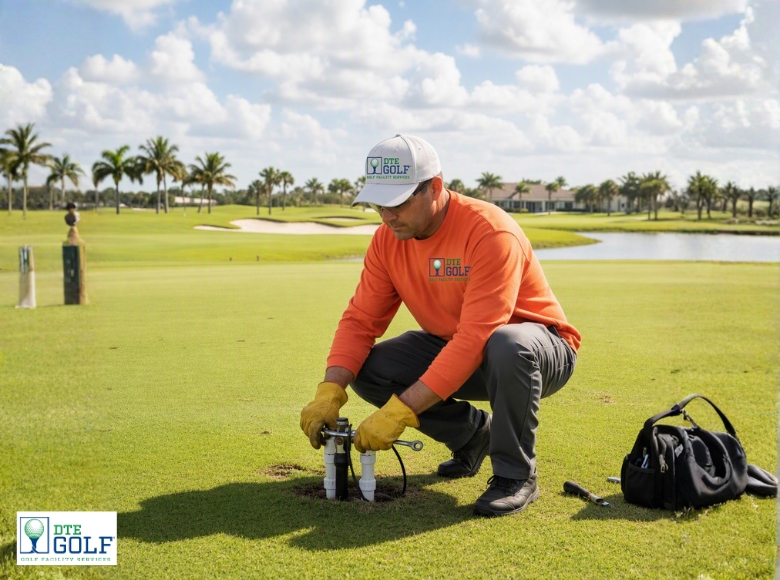
Here are seven strategies to water smarter, protect your soil, and keep playing conditions consistent.
Key Takeaways
- Smart golf turf management starts with zone-based watering.
- Soil moisture sensors can cut water use by 20% to 80%.
- Sandy soils call for light, frequent nutrient applications.
- A healthy rootzone makes every gallon work harder.
Top 7 Golf Turf Management Strategies
Let’s take a closer look at the strategies that work.
1. Divide the Golf Course Into Irrigation Zones
One fairway can have a sunny crown, a shaded corner, and a low pocket that stays wet. Water them all the same way, and you create wet and dry spots at once. Map soil texture, slope, shade, and traffic, then group areas with similar needs. Zoning is the foundation of golf turf management, and every other strategy here builds on it.
2. Use Soil Moisture Sensors for Precision Golf Turf Management
In-ground sensors suit fairways, while handheld meters work better on greens, where small areas demand frequent readings. According to the USGA, sensor-guided irrigation can save 20% to 80% of water compared with calendar-based or ET-based scheduling, and the savings start immediately. Place sensors in representative spots, such as low, dry, and shaded areas, and recheck them as sun angles shift.
3. Improve Golf Course Irrigation With ET-Based Scheduling
Evapotranspiration (ET) measures how much water soil and turf actually lose each day. USGA-referenced research shows that ET-based scheduling can save 20% to 50% compared with runtime-based watering. In Florida, afternoon storms can make a scheduled cycle pointless, so this discipline matters even more. Sound turfgrass management means pairing ET data with sensor readings so you know what to replace and what to skip.
Here is how the three main scheduling approaches compare.
Comparison Factor | Calendar-Based or Routine Scheduling | ET-Based Scheduling | Soil-Moisture Sensor-Based Scheduling |
Data Used | Fixed run times | Weather station ET and crop coefficients | Live soil moisture readings |
Water Savings | Baseline | 20% to 50% compared with runtime-based scheduling | 20% to 80% compared with calendar-based or ET-based scheduling |
Best For | Simple, low-budget systems | Courses with an on-site weather station | Fairways with variable soil conditions |
Main Limitation | Waters during rain and ignores variations between areas | Requires setup and staff training | Requires calibration, careful placement, and ongoing maintenance |
4. Audit the Golf Course Irrigation System for Efficient Water Use
Even perfect data cannot compensate for worn hardware. A clogged nozzle, tilted head, or mismatched sprinkler creates uneven coverage that no schedule can fix. Run catch-can uniformity tests, verify pressure, and replace worn components. Include hardware checks in every golf turf management plan. Include landscape beds in the audit, since ornamental plants connected to turf zones are often overwatered.
5. Test Irrigation Water Quality to Protect Golf Course Turf
Golf turf management in Florida increasingly involves reclaimed or other nonpotable water. University of Florida researchers note that rising potable water costs push facilities toward nonpotable sources and that poor water quality and salt buildup can create salinity problems.
Test irrigation water and soil on a fixed schedule, track sodium and total salts, and respond early with flushing irrigation, aeration, and wetting agents before the turf shows signs of stress.
6. Improve Soil Health and Rootzone Drainage for Golf Turf Management
Golf turf management does not stop at the surface because irrigation efficiency depends on the rootzone. Aeration relieves compaction, while regular, light sand topdressing dilutes organic matter and keeps the soil profile draining. These golf course maintenance basics pay off in every irrigation cycle. When a rootzone is beyond saving, rebuild it.
During the Twin Rivers Golf Club greens renovation, DTE Golf® removed two to three inches of the old greens mix, installed a 90/10 mix with Command soil amendment, and grew in TifEagle. The greens reopened in September 2024.
7. Optimize Golf Turf Management With Nutrient Applications for Sandy Soils
South Florida soils are generally sandy and low in organic matter, so they hold little water or few nutrients. Heavy fertilizer applications ahead of heavy rain can wash nutrients past the roots. Effective golf turf management means using smaller, more frequent applications, timed around the forecast and guided by soil tests. Fewer wasted inputs also help keep golf course maintenance budgets under control.
How DTE Golf® Supports Precision Golf Turf Management
DTE Golf® has served golf facilities across Florida and beyond for more than 30 years, maintaining over 800 holes of golf. As a division of Down To Earth Landscape & Irrigation, it brings irrigation management, agronomic support, and landscape services together under one roof.
Whether a property needs daily golf course maintenance, a full management program, or a renovation, DTE Golf® builds its golf turf management plan around your soil, your water, and your budget. The result is consistent playing conditions season after season.
Final Thoughts
Precision is not about gadgets. It is about knowing what every corner of your course needs and delivering exactly that. Start with zones and sensors, protect the rootzone, and let the data lead. Great golf turf management saves water and improves playing conditions.
FAQs
How Can Golf Courses Optimize Irrigation Without Compromising Turf Quality?
Golf courses can optimize irrigation with ET-based scheduling, soil moisture sensors, and localized watering. These methods deliver water according to turf needs, reducing waste while maintaining healthy, consistent playing surfaces.
What Role Does Soil Moisture Monitoring Play in Golf Turf Management?
Soil moisture monitoring helps turf managers identify dry and saturated areas before they damage turf health. It supports precise irrigation decisions, conserves water, and reduces disease risk from excessive moisture.
How Can Improved Drainage Prevent Turf Damage on Golf Courses?
Improved drainage removes excess water, reduces waterlogging and soil compaction, and allows roots to access oxygen. Proper grading, subsurface drainage, and suitable soil amendments help protect turf during Florida’s heavy rainfall.
Which Soil Conditions Are Most Important for Healthy Golf Course Turf?
Key soil conditions include adequate moisture, good drainage, sufficient oxygen, suitable pH, balanced nutrients, and minimal compaction. Together, these factors support strong root development and resilient turf.
How Can Precision Irrigation Reduce Golf Course Maintenance Costs?
Precision irrigation reduces unnecessary water use, pumping costs, and excessive fertilizer leaching. It also helps prevent turf stress and disease, potentially lowering repair, treatment, and routine maintenance expenses.
Ready to Put Precision to Work?
Your course deserves data-driven golf turf management. Talk to DTE Golf® about a customized turf and irrigation plan for your course. Contact us to learn more about our daily golf course maintenance services.