
A green can look perfectly healthy while its playing conditions are already starting to decline. A little softness underfoot, slower recovery from ball marks, or a putt that keeps coming up short can be the first signs that organic matter is building faster than the rootzone can handle. This is where golf course sand becomes one of the most important tools in a superintendent’s maintenance program.
Proper golf course sand topdressing dilutes organic matter, protects the putting surface, and maintains the firmness and consistency that golfers expect. But it is not as simple as spreading more sand and hoping for better greens. The sand type, application rate, timing, and frequency all matter, especially on Florida courses dealing with heat, humidity, rainfall, and heavy play. When you get those decisions right, you can feel the difference in every ball roll.
Key Takeaways
- University and USGA research points to light topdressing every 7 to 14 days during active growth, tighter than the “every few weeks” range often quoted.
- Industry survey data shows most facilities topdress every 14 to 28 days, but the best-conditioned greens skew toward the shorter end.
- Sand particle size affects disease pressure. Medium and medium-fine sands reduce anthracnose severity compared with coarser material.
- Florida course maintenance teams typically stay on a tighter interval because warm-season turf rarely goes fully dormant.
- An annual volume benchmark exists: courses applying at least approximately 20 cubic feet of sand per 1,000 square feet per year hold less organic matter than those applying less.
What Golf Course Sand Topdressing Actually Does to a Green
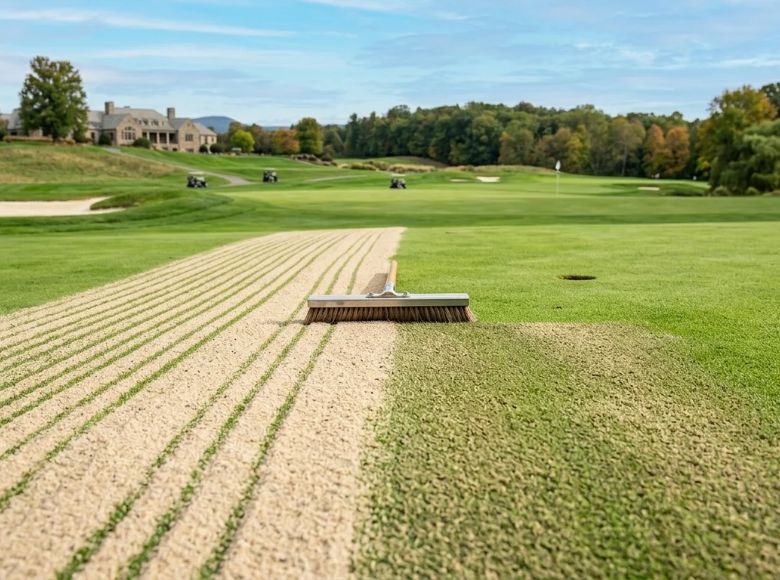
Topdressing is not cosmetic. It is a rootzone management tool. Every light dusting dilutes the organic matter turf sheds as it grows, keeps that layer from compacting into a moisture-holding sponge, and gradually builds a firmer, sand-based surface that drains and putts consistently.
When you skip it, organic matter accumulates in distinct layers rather than blending in. This structural problem restricts water movement, oxygen diffusion, and eventually root depth. Golf course sand management belongs alongside aeration as one of the two pillars of good golf course maintenance, not as an extra layer on top of routine mowing and irrigation.
How Often Should Golf Course Sand Be Applied to Putting Greens?
Most sources land on a wide, noncommittal range for topdressing frequency without saying which end applies to your course. Studies at Rutgers University found that topdressing every two weeks improved turf quality and reduced anthracnose severity, and that finding repeats across the literature: sand is typically applied somewhere between every 7 and 28 days, with the exact interval set by turf growth rate and the broader program around it.
A regional superintendent survey backs this up: 41% of respondents light topdress every 14 days, 24% every 21 days, and only 8% run a full 7-day cycle. The best-conditioned facilities cluster at the tighter end, not the loose monthly schedule circulated elsewhere.
Topdressing Frequency | Survey Respondents | What It Suggests |
Every 7 days | 8% | Used by a smaller group following a very frequent light topdressing program |
Every 14 days | 41% | Most commonly reported interval in the survey |
Every 21 days | 24% | A common moderate frequency |
Every 28 days | Not reported | Falls within the broader research range but was not included in the survey figures cited above |
Research range | Every 7 to 28 days | Frequency should be adjusted based on turf growth rate and the overall maintenance program |
How Golf Course Sand Application Rate and Frequency Work Together
The more often you topdress, the less sand each pass needs, which is why “light and frequent” beats “heavy and occasional” in every study on the subject. A common starting point is 100 to 200 pounds of dry sand per 1,000 square feet per application during active growth. Over a full season, courses applying at least 20.3 cubic feet of sand per 1,000 square feet per year carry less organic matter than those applying lower annual totals. This is a number worth tracking across an entire golf management calendar, not just per application.
Golf Course Sand Types: Why Particle Size Isn’t a Minor Detail
Not all topdressing sand behaves the same once it is in the canopy. Survey data shows medium sand (0.25 to 0.5 mm) is the most widely used particle size, at roughly half of respondents, followed by fine sand, and that preference isn’t arbitrary.
Coarser sand is harder to incorporate and more likely to be picked up by mowers, while medium and medium-fine sands produce equal or lower disease severity. Coarse sand left sitting on the canopy also dulls reels faster and disrupts ball roll longer. This is a cost most comparisons of golf course sand types skip over entirely.
Signs a Putting Green Is Overdue for Sand Topdressing
The calendar gets you close; the turf tells you the rest. Watch for lingering footprints after a group has passed, a spongy feel underfoot near collars and low points, ball marks that stay deep instead of releasing, standing moisture after irrigation, and thinning around high-traffic zones like cup-cutting areas. Any of these showing up before the scheduled application means the interval needs tightening, not the sand itself.
Can You Apply Too Much Golf Course Sand?
Yes, and the mistake usually shows up months later, not immediately. Infrequent, heavy applications create distinct layers of sand and organic matter that restrict water movement, oxygen diffusion, and root development. They also disrupt ball roll for days and are harder to work into the canopy cleanly, which is why light, frequent applications have become the standard rather than a stylistic preference.
Seasonal Adjustments and Why Florida Programs Run Tighter
Cool-season courses get a built-in break: growth slows in summer heat and again in winter dormancy, naturally widening the interval. Florida course maintenance rarely gets that luxury.
Warm-season turf like bermudagrass keeps producing organic matter through most of the calendar year, which is why programs here tend to sit at the 7- to 14-day end nearly year-round rather than easing off seasonally. Post-aeration periods are the one exception everywhere: tighter, lighter applications fill holes faster and speed recovery regardless of climate. The same discipline extends to sand traps and other high-wear areas, though putting greens demand the tightest tolerances by far.
For the comprehensive research behind these numbers, the USGA Green Section’s topdressing research is worth reading directly.
How DTE Golf® Helps With Sand Management
DTE Golf® builds sand and turf care programs matched to each course’s turf type, growth rate, and Florida’s near-year-round growing season, not a generic monthly schedule. That means tracking rate and frequency together, choosing sand particle size with disease pressure in mind, and adjusting the plan through every season rather than reacting after a green has already gone soft.
Final Thoughts
Light topdressing every 7 to 14 days, matched to turf growth and backed by the right particle size and annual volume, consistently outperforms the vague “every few weeks” advice that circulates online. A properly run program is one of the highest-leverage, lowest-visibility investments a course can make. The firmest, truest greens are not the result of guesswork. They come from tracking rate, frequency, and volume together.
FAQs
What factors determine the ideal sand topdressing frequency for putting greens?
Turf species and growth rate, climate and dormancy patterns, traffic volume, sand particle size, and cumulative annual sand volume all shape the right interval, which is why a single “every X weeks” rule rarely fits every course.
How does putting green traffic influence the frequency of sand applications?
Higher rounds per day accelerate wear, compaction, and footprinting, especially near collars and cup positions. Courses with heavy daily play or tournament stretches typically need the tighter end of the 7- to 14-day range rather than stretching toward 21 to 28 days.
What signs indicate that a putting green needs another sand topdressing?
Lingering footprints, a spongy feel underfoot, deep ball marks that don’t release, standing surface moisture after irrigation, and visible thinning around high-wear zones are all reliable indicators that the interval needs tightening.
Can excessive sand topdressing negatively affect putting green turf and rootzone performance?
Yes, though the bigger risk is usually infrequent, heavy applications rather than frequent, light ones. Heavy dosing without matching frequency creates layering that restricts water movement, oxygen diffusion, and root development.
How should sand application frequency change based on turf growth, aeration, and seasonal conditions?
Tighten the interval during active growth and immediately after aeration to speed hole recovery; ease off during dormancy or slow growth periods. Warm-season courses, including most Florida course maintenance programs, generally stay closer to the 7- to 14-day interval year-round.
Ready to See What a Research-Backed Program Could Do for Your Greens?
Talk to DTE Golf® today to develop a topdressing plan built around your course, turf conditions, maintenance goals, and playing demands. Instead of relying on a generic calendar, you can have a program designed to support consistent turf quality, smoother playing conditions, and long-term green performance.