
Your fairways do not lie. If your turf struggles, your irrigation system is the first place to look. When you walk any great golf course before sunrise, you will notice something that most golfers never do: the golf course irrigation system. It plays a vital role.
For large commercial properties, a golf course irrigation system is even more important. There are hundreds of acres, multiple turf zones, and microclimates that shift from hole to hole. A system that works well on a nine-hole municipal golf course will not work for a sprawling, championship-level layout. You need the right strategy.
Here is what every large property operator needs to know about golf course irrigation systems and why making the right decision now protects your turf, your budget, and your reputation for years to come.
Why Large Golf Course Irrigation Systems Require a Different Approach
Size changes everything in golf course irrigation. An average 18-hole golf course pumps roughly 2,000 gallons of water every minute. This water must be applied across different areas of your property, such as extended fairways, diverse rough areas, and multiple tee complexes. One of the most common mistakes large property operators make is treating all zones the same.
Applying uniform irrigation across different zones wastes water, increases disease pressure, and produces inconsistent turf conditions. Smart and effective golf course irrigation for large properties begins with one principle: precision.
Top Golf Course Irrigation System Options for Large Properties
1. Central Control and Satellite-Based Irrigation Systems
For large-scale operations, central control systems are the gold standard. These systems link every sprinkler head, valve, and controller across the entire property to a single command hub, often cloud-based. This gives your superintendent real-time oversight of all zones from a single screen or mobile device.
Satellite-based irrigation systems take this further by using standalone controllers at each irrigation station. Each controller communicates independently with the central system. If one station goes down, the rest of the course continues to operate. This redundancy is invaluable for large commercial properties, where even a single failure can affect dozens of holes.
Key benefits include zone-specific customization, remote adjustments during weather changes, and detailed reporting that supports smarter long-term turf management decisions.
2. Smart, Weather-Integrated, and ET-Based Irrigation Systems
Modern golf course irrigation systems do not simply follow a schedule—they respond to environmental conditions in real time. Evapotranspiration-based systems calculate how much water the turf has lost due to heat, wind, and sunlight, and replace only what is necessary.
On large properties where conditions vary significantly, this technology is highly effective. When paired with on-site weather stations and soil moisture sensors, these systems can reduce water consumption by 20% to 35% compared to fixed-schedule systems without compromising turf quality. The result is lower water costs, reduced disease pressure, and healthier turf.
3. Zone-Specific Multi-Head Rotary Irrigation Systems
Large properties require irrigation systems that adapt to different turf requirements simultaneously. Multi-zone rotary head systems achieve this effectively.
Greens receive frequent, lighter irrigation cycles, sometimes supplemented with mid-afternoon applications during heat events to maintain firmness and smooth ball roll. Fairways are watered less frequently but more deeply to promote root growth of six to eight inches. Rough areas require significantly less water—sometimes up to 60% less than fairways—and are managed under mild stress to control growth and conserve resources.
Elevated areas, slopes, and bunker surrounds receive targeted irrigation. This zone-specific approach ensures that every area receives exactly what it needs.
4. Pump Station Upgrades and Pressure-Regulated Distribution Systems
Even the best irrigation heads cannot compensate for a pump station that fails to maintain consistent pressure. Uneven pressure leads to inconsistent coverage, resulting in dry areas and oversaturated sections.
High-capacity, variable-speed pump stations act as the backbone of large property irrigation systems. They regulate pressure based on system demand, eliminate damaging pressure fluctuations, and improve energy efficiency compared to fixed-speed systems.
With proper mainline sizing and flow monitoring, a well-designed pump station upgrade can extend the lifespan of the entire system.
Golf Course Irrigation System Maintenance Best Practices
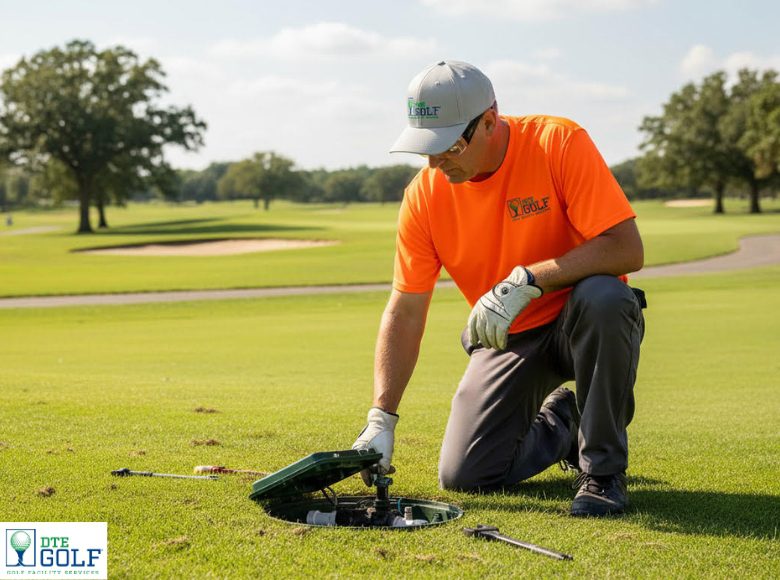
Even the most advanced systems require consistent maintenance. Clogged nozzles, misaligned heads, pressure leaks, and failing valves can quickly escalate into significant problems. On large properties, these small issues compound rapidly, and by the time turf damage is visible, repairs become more complex.
Routine maintenance should include filter cleaning, sprinkler inspections, flow testing, and pressure checks, along with seasonal system audits. Industry research shows that a thorough audit can identify water waste of up to 10% annually, resulting in substantial cost savings.
Successful golf courses follow a proactive maintenance schedule—just as they do with mowing—ensuring long-term system efficiency and performance.
Choosing the Right Golf Course Irrigation System for Large Properties
Every large property is unique. Before selecting a system, it is important to evaluate:
- Course size, layout, and total irrigated area
- Soil composition and water retention capacity
- Climate conditions and water availability
- Existing infrastructure and upgrade feasibility
- Staffing structure and long-term operational goals
A professional evaluation from a qualified golf facility services provider is the most effective first step toward making the right investment.
Final Thoughts on Golf Course Irrigation Systems for Large Properties
A high-performing golf course is not created by chance. It is built with precision, and the irrigation system plays a central role. On large properties, precision, adaptability, and proactive maintenance separate average conditions from championship-level performance.
The right system does more than irrigate—it protects your investment, improves playability, and delivers consistent results across every hole.
Frequently Asked Questions About Golf Course Irrigation Systems
What is the best golf course irrigation system for large properties?
The best option is a central control system combined with satellite controllers and ET-based smart technology. This setup enables precise, zone-specific irrigation across large areas while ensuring efficiency and consistent turf performance.
How often should a golf course irrigation system be maintained?
Routine maintenance should be performed weekly for inspections and monthly for system performance checks. Seasonal audits are also essential to identify inefficiencies and prevent long-term damage.
What are the benefits of upgrading a golf course irrigation system?
Upgrading improves water efficiency, reduces operational costs, and enhances turf health. Modern systems provide real-time control, improved pressure management, and advanced weather integration for better performance.
How does a golf course irrigation system handle drought conditions?
Advanced systems use evapotranspiration data, soil sensors, and weather inputs to optimize water usage. They prioritize critical areas such as greens while reducing irrigation in less critical zones to conserve water and maintain turf quality.
Stop Relying on Outdated Systems and Guesswork
Partner with experts who understand large-scale golf course irrigation. With DTE Golf®, you gain more than a service—you gain a long-term performance strategy tailored to your course.
Schedule your professional irrigation assessment today.