
Golfers do not notice great turf. They only notice bad turf. This asymmetry is the quiet pressure every superintendent lives with, and it is why golf turf management is one of the most important operational decisions any facility makes.
When you get it right, golfers simply enjoy the round. When you get it wrong, they talk about it, post about it, and choose to play somewhere else.
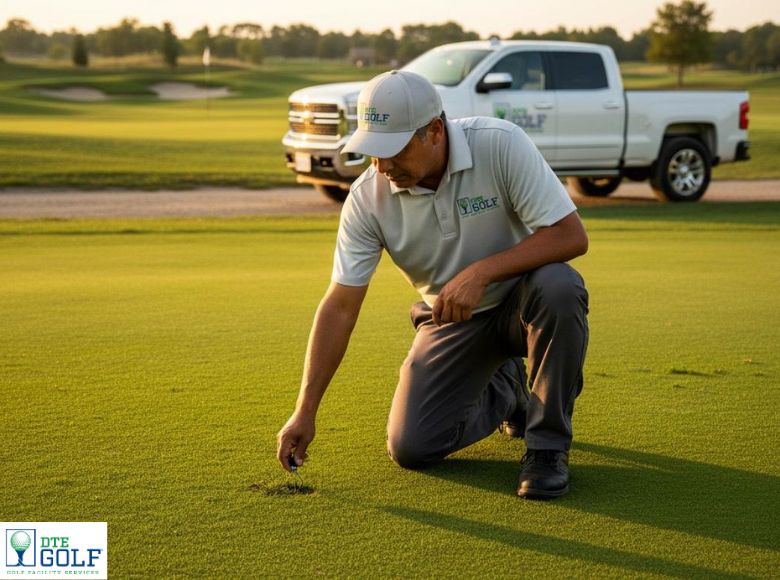
At DTE Golf®, we have managed 800+ holes across Florida for over 30 years. Our ICARE values Integrity, Community, Accountability, Relentlessness, and Excellence are not marketing languages. They are the standard applied to every green, fairway, and tee box we touch. Here is how we approach turf management, and what your facility should be doing right now.
Know Your Grass Before You Manage It
Managing turfgrass is a precision science, not an instinct. The first step is understanding what you are growing and exactly what your grass requires.
Warm-season grasses like Bermudagrass and Zoysiagrass thrive in Florida’s heat and humidity. Cool-season varieties, including bentgrass and perennial ryegrass, are used in northern facilities and for overseeded winter surfaces. Each species has distinct thresholds for mowing height, nutrient uptake, irrigation frequency, and heat tolerance.
Managing them the same way will lead to poor results.
DTEGolf®’s turfgrass management programs are built around each course’s specific grass species, soil composition, microclimate, and play volume, never generic templates. This level of customization is one of the key reasons our facilities consistently outperform industry benchmarks for playing conditions and turf quality.
Soil Health: The Foundation Everything Else Rests On
You cannot manage turf without managing the soil it grows in. Soil is home to essential microbes and determines how efficiently roots absorb water, nutrients, and oxygen. If neglected, no amount of fertilizer or irrigation can compensate.
Soil testing should be conducted at least once annually. Results reveal pH levels, nutrient deficiencies, and imbalances in organic matter that directly affect turf performance.
A healthy soil pH typically ranges between 6.0 and 7.0, keeping nutrients bioavailable. Without proper balance, even expensive inputs can become locked out of the root zone. The USGA Green Section recommends soil testing as the baseline of any effective golf course maintenance program.
At DTE Golf®, we go further by combining soil data with agronomic expertise to build fertility programs based on current conditions not last year’s schedule. When agronomy leads, costs decrease and turf quality improves.
Aeration and Topdressing Are Not Optional
If there is one practice that separates courses golfers love from those they tolerate, it is consistent, well-executed aeration.
Compacted soil is a major threat to turf health. It blocks the movement of oxygen, water, and nutrients that roots need to grow deep and strong.
Without depth, turf thins under heat stress, becomes more susceptible to disease, and recovers slowly from heavy play. Core aeration breaks this cycle by removing plugs of compacted soil, opening the root zone, and strengthening the turf’s foundation.
When paired with topdressing, aeration improves surface smoothness and moisture retention. The result is stronger, smoother greens that recover faster and maintain firmness longer.
According to Penn State’s Center for Turfgrass Science, aerification combined with sand topdressing is one of the most reliable methods for reducing organic matter buildup and maintaining consistent green speed over time.
Mowing, Fertilization, and Pest Control: The Ongoing Disciplines
Effective turfgrass management is not built on occasional fixes. It depends on consistent execution of three core disciplines.
Mowing sets the ceiling for surface quality. Cutting too low removes protective leaf tissue, while cutting too high creates inconsistent ball roll. Frequency, blade sharpness, and mowing patterns all influence turf health and playability.
Fertilization must follow turf needs, not the calendar. Slow-release nitrogen applied during active growth guided by soil data builds density and root strength. Phosphorus and potassium further support cell structure and disease resistance. DTE Golf®’s customized fertilization programs remove guesswork and improve outcomes.
Pest and disease control requires an Integrated Pest Management (IPM) approach. This combines biological controls, cultural practices, and precisely timed treatments to minimize impact while maximizing protection. The Golf Course Superintendents Association of America (GCSAA) recommends IPM as the industry standard, and it is the approach DTE Golf® implements across every property.
Why DTE Golf® Delivers What Others Cannot Match
Golf turf management rewards experience, punishes shortcuts, and demands accountability. With more than 30 years in the field and over 800 holes managed, DTEGolf® operates with a proven approach.
Our model eliminates surprises: no unexpected capital expenditures, no staffing gaps during peak demand, and no reactive scrambling when systems fail.
We provide a fully integrated service model that includes turf management, irrigation, golf shop operations, and cart fleet maintenance all under one accountable partnership with complete transparency.
The best-performing facilities are not doing it alone. They partner with experts who treat their course with consistent, disciplined care.
Final Thoughts on Effective Golf Turf Management
Exceptional turf conditions are never accidental. They result from disciplined agronomy, consistent maintenance, and a clear understanding of how soil, grass, and play volume interact throughout the season.
When these elements work together, greens stay healthier, surfaces remain consistent, and golfers notice the difference in every round.
Facilities that prioritize professional golf turf management not only protect turf quality but also improve golfer satisfaction and long-term course performance. With the right expertise and a proactive approach, any course can maintain strong, resilient greens that perform under pressure.
FAQs
- What are the key practices involved in effective golf turf management?
Key practices include proper mowing, balanced fertilization, irrigation management, and regular aeration. These support strong root development and healthy grass growth, while consistent monitoring helps identify pests, diseases, and stress early. - How does golf turf management improve the strength and health of greens?
It ensures the right balance of nutrients, water, and maintenance. Practices like aeration and topdressing improve soil structure and root growth, helping greens remain firm, smooth, and resilient under heavy play. - What mowing techniques are recommended for healthier turf?
Consistent mowing at the correct height is essential. Always use sharp blades to avoid tearing the grass, and alternate mowing patterns to reduce stress and encourage even growth. - How often should irrigation be adjusted in a turf management plan?
Irrigation should be adjusted regularly based on weather, soil moisture, and turf conditions. During warmer periods, adjustments may be needed weekly or more frequently to prevent overwatering or drought stress. - What common mistakes should be avoided to prevent turf damage?
Avoid overwatering, mowing too short, and over-fertilizing. Neglecting soil health and poor traffic management can also damage turf. Regular inspections and balanced practices help prevent long-term issues.
Ready to Raise the Standard on Your Course?
Strong, healthy greens are not an accident. They are the result of disciplined science, experienced teams, and the right management partner.
Contact DTE Golf® today for a free consultation and discover how our 30+ years of expertise, ICARE-driven culture, and fully integrated service model can elevate your course and keep it performing at its best year-round.