
Walk any golf course built before the early 2000s, and you’ll find the same quiet culprit sabotaging the round: a tired, washed-out golf bunker. Contaminated sand, crumbling edges, and standing water after every storm. It is rarely dramatic, but it chips away at playability, pace of play, and the first impression golfers form of your entire facility. For aging courses, restoring bunkers is not cosmetic. It’s one of the highest-leverage investments in course presentation.
Key Takeaways
- Unlined bunker sand typically fails within 5 to 7 years; lined systems can stretch past 20 years.
- Poor bunker drainage is the leading cause of washouts, sand contamination, and playability complaints.
- A well-planned golf bunker restoration improves both aesthetics and long-term maintenance costs.
- Liner selection, edge shaping, and drainage design matter more than sand brand alone.
- Restoration is also a chance to modernize outdated golf course design for how the game is played today.
What Is Golf Bunker Restoration?
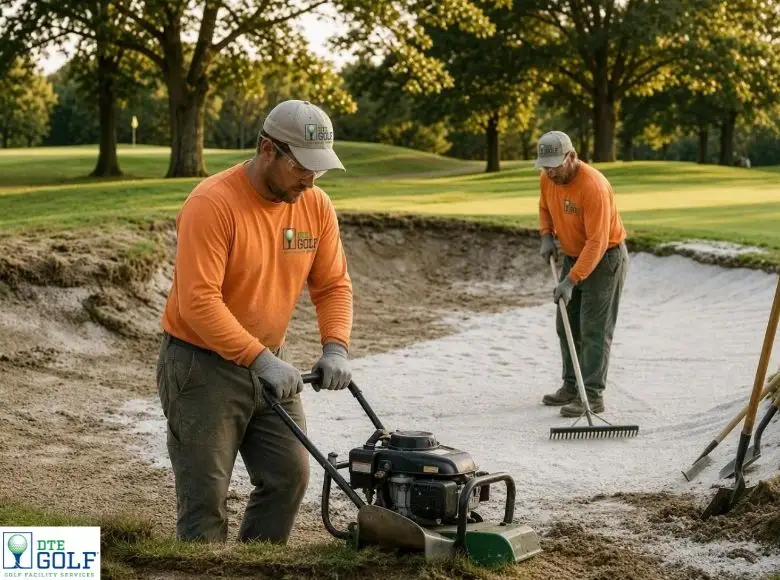
Golf bunker restoration is the process of rebuilding a hazard from the ground up, regrading the basin, repairing or installing drainage, adding a liner, reshaping eroded edges, and replacing sand rather than simply topping off what’s already there. It’s distinct from routine bunker maintenance, such as raking, edging, and spot filling, which manages a bunker’s day-to-day appearance but can’t reverse structural decline once drainage and sand quality have broken down.
Why Golf Bunker Restoration Matters for Aging Golf Courses
Courses built decades ago were rarely engineered to today’s drainage standards, sand specifications, or maintenance budgets. Over time, silt and native soil migrate up into the sand, rainfall pools instead of percolating, and edges that once framed a hole crisply start to slump and blur.
The result compounds: more labor hours per bunker, more golfer complaints about “fried egg” lies and standing water, and a course that photographs and plays older than it needs to. Because bunkers sit at the intersection of golf course turf, drainage infrastructure, and design intent, neglecting them also puts additional pressure on the surrounding golf course grass and green complexes.
Golf Bunker Restoration by the Numbers
Industry data makes the case plainly. According to golf course architects writing for the Golf Course Superintendents Association of America, a bunker renovation is an opportunity to improve a golf course’s overall appearance while reducing long-term maintenance, and conventional sand-on-dirt construction typically lasts only five to seven years before it needs rebuilding.
Liner systems change that math considerably. Some contractors report unlined bunkers needing rework in six to seven years, while properly lined systems can last 20-plus years, with sand replacement as the only ongoing cost. That gap is the entire business case for getting it right the first time.
Sand on Dirt vs. Liner Systems vs. Full Golf Bunker Reconstruction
Reconstruction Method | Sand on Dirt (Conventional) | Fabric/Geotextile Liner | Full Reconstruction with Rigid Liner |
Life Expectancy | 5 to 7 years | 10 to 15 years | 20+ years |
Upfront Cost | Lowest | Moderate | Highest |
Drainage Performance | Poor to fair, prone to washouts | Good, separates sand from subsoil | Excellent, engineered sub-drainage |
Contamination Risk | High, soil migrates into sand | Low to moderate | Very low |
Best Fit | Tight budgets, short-term fix | Mid-range renovation budgets | Aging courses planning a long-term fix |
The choice usually comes down to how long you plan to own the problem: patch it again in five years, or engineer it out for two decades.
Golf Bunker Reconstruction Case Study: What a Full Bunker Rebuild Looks Like
Dalton Golf & Country Club in Georgia offers a useful real-world reference point. Nearly 40 years had passed since any major course improvements, and the layout, including tees, fairways, greens, irrigation, and every golf bunker on the property, was showing its age.
The renovation team rebuilt every bunker with a rigid liner system and installed premium angular sand across roughly 40,000 square feet of hazards as part of an eight-month, course-wide overhaul. The lesson for aging facilities isn’t the price tag; it’s the sequencing. Bunkers were addressed alongside drainage and turf work, not as an isolated patch job, which is exactly why the result held up.
Best Practices for Golf Bunker Restoration
- Fix drainage first. No liner or sand upgrade compensates for a basin that can’t move water away from the playing surface.
- Choose sand to spec, not just by color. Particle size and angularity affect firmness, splash, and how consistently a golf bunker plays from one hazard to the next.
- Reshape edges to current mowing patterns. Blurred, slumped edges usually trace back to how the surrounding golf course turf is maintained, not just erosion.
- Sequence bunkers with greens and tee work. Restoring hazards alongside broader golf course maintenance projects reduces mobilization costs and course closure time.
- Revisit outdated bunker placement. Modern driving distances have made some original hazards irrelevant. Restoration is the moment to correct dated golf course design decisions, not just rebuild them in place.
- Budget for liners even if phased. A geotextile or rigid liner can nearly triple the useful life of the investment compared with sand on dirt.
How DTE Golf® Helps With Golf Bunker Restoration
DTE Golf® has spent more than 30 years maintaining, renovating, and managing golf facilities across the Southeast, and bunker restoration sits squarely at the intersection of our Renovation and Construction and Daily Golf Course Maintenance services.
Our teams handle everything from drainage diagnostics and liner selection to final sand placement and edge shaping, backed by hands-on golf turf management experience across 800+ holes.
Because we manage courses long after construction wraps, we build bunkers to survive real-world play and weather, not just look sharp on opening day. Whether you need a single hazard rebuilt or a full-course bunker program, DTE Golf® brings the agronomic and construction expertise to get it right the first time.
Final Thoughts
Bunkers are one of the most visible signs of a course’s age, and one of the most fixable. A restoration built on solid drainage, the right liner, and sand to spec doesn’t just look better next spring; it protects your maintenance budget for the next two decades. For aging courses, that’s not a luxury upgrade. It’s overdue infrastructure work with a scoreboard everyone can see.
FAQs
How Do You Determine Whether a Golf Bunker Needs Restoration or Complete Reconstruction?
Look at the extent of damage: if sand contamination, edge erosion, or drainage issues are isolated and the base or liner is still sound, restoration, including new sand, edge repair, and a drainage tune-up, is usually enough. If washouts are chronic, the liner has failed, or the underlying structure is compromised, full reconstruction is the more cost-effective long-term fix.
What Role Does Bunker Drainage Play in the Long-Term Performance of Aging Golf Bunkers?
Drainage is the single biggest factor in bunker longevity. Poor drainage causes washouts, sand contamination, and soil migration, all of which shorten sand life and increase maintenance. Well-designed internal and surface drainage keeps sand in place and prevents the erosion that drives premature rebuilds.
How Can Golf Course Managers Select the Right Bunker Sand for Consistent Playing Conditions?
Choose sand based on lab-tested criteria: drainage rate, particle angularity, low fines and gravel content, angle of repose relative to bunker slope, and firmness, as measured by penetrometer reading, to avoid “fried egg” lies. Cost shouldn’t be the deciding factor; performance consistency matters more for playability.
What Are the Most Common Structural Problems Found During Golf Bunker Restoration?
Common culprits include failed or missing liners, soil contamination in the sand, inadequate or clogged drainage pipes, eroded or undercut edges, and incorrect slope-to-sand angle ratios that cause sand to wash or slide out of place.
How Can Modern Bunker Restoration Techniques Reduce Future Maintenance Requirements?
Using fabric or rigid liners to separate sand from soil, engineering proper subsurface drainage, matching sand angle of repose to bunker slope, and stabilizing edges with turf all reduce contamination, washouts, and hand raking, cutting labor and resanding costs over the bunker’s lifespan.
Ready to Stop Patching and Start Restoring Your Golf Bunkers?
Your bunkers deserve more than a quick fix. Patch jobs might buy you a season, but they rarely address what’s actually causing the breakdown: poor drainage, the wrong sand, or a design that was never built for how your course plays today. Talk to DTE Golf® about a full bunker restoration plan, designed around your course’s soil, drainage, and play patterns.