
First impressions on a golf course are formed immediately. Your turf quality is at the center of that experience. The consistency of your fairways, the precision of your cut, and the playability of your surfaces all reflect one important decision made behind the scenes: choosing the right golf course lawn mower.
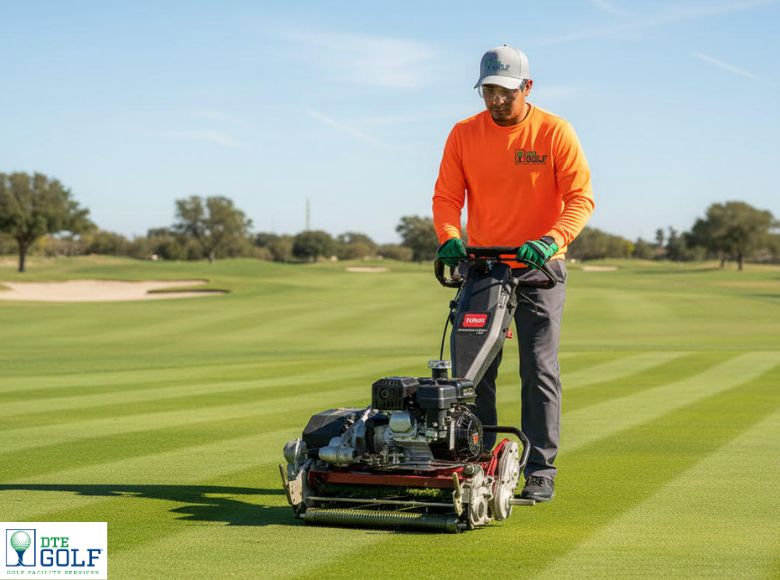
Every golfer recognizes the difference the moment they step onto a well-maintained fairway. The turf feels firm underfoot, the cut is clean and uniform, and the ball sits perfectly for the next shot. While most players may not identify the reason, the impact is undeniable. At the core of that experience is the golf course lawn mower—a key piece of equipment that directly influences turf health, aesthetics, and overall course performance.
For superintendents and course operators, selecting the right golf course lawn mower is not just a maintenance decision; it is a strategic investment that defines turf quality, enhances playability, and shapes how golfers perceive the entire course.
Why Golf Course Lawn Mowing Requires Zone-Specific Precision
One of the most fundamental errors in golf course management is treating mowing the same for all areas. Greens, fairways, tees, and roughs are four completely different turf systems—each requiring a different machine, cutting mechanism, and height of cut, all adjusted by fractions of an inch.
Putting greens are typically cut between 0.100 and 0.125 inches using reel mowers. Fairway management requires wide-deck reel units capable of cutting large acreage efficiently while maintaining the uniformity that separates great courses from average ones. Roughs tolerate rotary mowers that cut at higher heights and handle uneven terrain without the calibration demands of reel equipment.
The wrong mower in any of these zones is not just inefficient—it is actively damaging. A rotary mower on putting green tear tissue rather than cutting it. An underpowered reel unit struggling through heavy fairway grass produces an uneven cut that golfers can see and feel. Matching the machine to the zone is the first law of golf turf management.
Reel vs. Rotary Golf Course Lawn Mowers: Choosing the Right System
The debate between reel and rotary mowers is not a debate for experienced operators—it is a question of application.
Reel mowers use multiple blades that rotate against a fixed bed knife to produce clean, precise cuts at very low heights. They are the only appropriate tool for greens, tees, and premium fairway surfaces where turf quality and playing speed matter most. The cut is clean enough to promote rapid healing of the grass blade, reduce entry points for disease, and produce stripe patterns and surface consistency that define championship-quality conditions.
Rotary mowers use a single high-speed spinning blade to cut at higher heights. They are faster, more versatile across terrain, and handle rougher secondary areas where absolute precision is less important. Modern commercial rotary units have improved significantly in blade design and cutting efficiency, making them reliable workhorses for rough maintenance on large properties.
For most courses, the optimal equipment program includes both. Reel units are dedicated to premium zones, while rotary units handle volume work in secondary areas. This dual approach is standard practice in advanced golf course maintenance programs—this is exactly how DTE Golf® equips and deploys its maintenance teams.
Golf Course Lawn Mower Maintenance and Equipment Performance
Here is a fact that surprises operators new to professional golf course turf management: a dull reel mower is worse than no mower at all.
When reel blades lose their edge or fall out of adjustment with the bed knife, they stop cutting grass and start tearing it. The grass blade is crushed and ripped rather than sliced. The wound is ragged and wide, creating a perfect entry point for fungal disease and stress. The tips turn yellow within 24 to 48 hours, giving fairways and greens a worn and tired appearance that no amount of rolling or irrigation can correct.
Golf course superintendents with sharp, properly maintained reels consistently outperform those using newer machines that are poorly maintained.
The standard protocol for reel maintenance in a professional program includes daily cleaning and inspection, weekly bed knife adjustment checks, regular backlapping or professional grinding on schedule, and roller calibration to prevent scalping on uneven surfaces. Skipping any of these steps will quickly show a visible impact on turf quality.
Golf Course Lawn Mowing Frequency, Patterns, and Playability
Beyond the machine itself, fairway management success depends on when and how mowing occurs. Cutting frequency, pattern rotation, and timing relative to dew and heat conditions determine whether mowing improves or stresses the turf.
Mowing should take place after morning dew has lifted but before midday heat peaks. Cutting wet turf clogs equipment, compresses the canopy, and produces an uneven finish. Cutting during peak heat adds stress to turf already working to regulate temperature.
Pattern rotation is equally important. Repeated mowing in the same direction creates grain, where turf grows in one direction and causes compaction along repeated wheel tracks. Effective golf course management rotates mowing direction regularly to maintain upright turf, true surfaces, and consistent ball roll.
For most 18-hole courses in active play, greens are cut daily, and fairways are cut three to five times per week, depending on growth rate and season. Roughs are typically cut weekly. During high-heat periods, mowing heights are slightly increased to reduce stress. This is a key detail that separates proactive maintenance from reactive damage control.
Modern Golf Course Lawn Mowing Technology and Efficiency
Today’s top-performing golf course lawn mower units are designed for both efficiency and precision. GPS-guided mowing paths reduce overlap and missed areas on large fairway sections. Hybrid and electric drive systems reduce fuel consumption and minimize ground compaction compared to older models. Telematics allow managers to track equipment usage, monitor maintenance schedules, and optimize performance across the entire fleet.
For operators managing large properties with limited labor resources, these efficiencies add up quickly. A well-structured mowing program using the right equipment for each zone can reduce total mowing hours by 15 to 20 percent compared to less organized approaches. This allows staff to focus on essential agronomic tasks that cannot be automated.
Final Thoughts on Golf Course Lawn Mowers and Turf Quality
Great turf does not happen by chance. It is achieved through the right equipment, disciplined practices, and attention to detail that golfers notice immediately. The mower you choose today directly shapes the playing experience tomorrow.
Golf Course Lawn Mower FAQs
What is the best golf course lawn mower for maintaining turf quality?
The best golf course lawn mower is a reel mower designed specifically for greens, fairways, or roughs. It delivers a precise, clean cut that promotes uniform turf growth. Choosing the right type depends on the specific area and desired playing conditions.
How does a golf course lawn mower affect turf health?
A high-quality golf course lawn mower ensures a clean cut rather than tearing the grass, which reduces stress and disease risk. Proper mowing encourages dense, healthy turf growth and improves overall surface consistency and playability.
How often should a golf course lawn mower be used for best results?
Mowing frequency depends on turf type and season, but greens are typically cut daily, while fairways are mowed several times per week. Consistent mowing maintains optimal height and turf density. Adjustments are made based on growth rate and weather conditions.
What features should you look for in a golf course lawn mower?
Key features include precision cutting units, adjustable height of cut, and consistent blade performance. Durability, ease of maintenance, and fuel or energy efficiency are also important. Advanced models may include GPS tracking and automated controls for improved performance.
Your Turf Tells the Truth Is It Saying What You Want? If Not, Act Today!
The difference between a course golfers return to and one they quietly avoid is often not the scorecard. It is the turf underfoot, the stripe on the fairway, and the speed on the green. Consistency comes from a disciplined, professional mowing program supported by the right equipment.
DTE Golf® has maintained more than 800 holes across Florida for over 30 years. Our trained technicians use precision-calibrated equipment, zone-specific mowing protocols, and structured maintenance programs to deliver measurable results on every flag, every fairway, and every visit.