
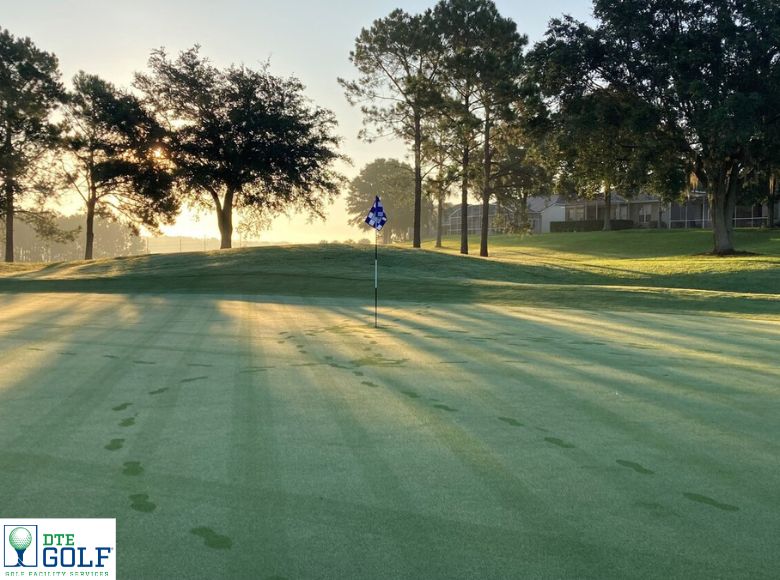
Walk any well-kept golf course in the early morning, and you will feel the difference underfoot: firm, even, and vibrant turf. This turf condition is not an accident. It is the result of deliberate, disciplined turf health improvement carried out before the first golfer ever arrives.
Most turf problems do not announce themselves loudly. They develop quietly beneath the surface through compacted soil, depleted nutrients, and irregular irrigation. By the time the grass starts to thin or discolor, the damage has often been developing for weeks. The professionals who manage elite courses understand this reality. That is why the best golf course turf maintenance programs are built around prevention rather than recovery.
Whether you are managing 18 holes in a Florida summer or supervising a municipal course through heavy seasonal traffic, these techniques are the difference between grass that simply survives and grass that consistently performs.
Improve Turf Health by Starting with the Soil
Healthy turf starts about six inches below what you can see. Soil structure determines how well roots develop, how efficiently water and nutrients move, and how the grass handles stress. That is why turf health improvement begins with a proper soil test, not a bag of fertilizer.
A basic soil test tells you pH, nutrient levels, and organic matter content. Grass performs best in a pH range of 6.0 to 7.0. Outside that window, nutrients become less available regardless of how much you spend on inputs. You need to understand your soil before you treat it. It is not optional. It is the foundation of every sound golf course lawn care plan.
Sandy soils drain too quickly and struggle to retain nutrients. Clay-heavy soils compact easily and restrict root development. Properly timed soil amendments help correct both issues before they damage turf from the inside out.
Why Aeration Is Essential for Golf Course Turf Maintenance
If there is one technique that separates well-maintained courses from struggling ones, it is consistent, properly executed aeration. Compacted soil blocks air, water, and nutrients from reaching roots. The grass above ground may appear healthy right up until the point it fails under stress.
Core aeration removes small plugs of soil and immediately relieves compaction. Combined with sand backfilling and topdressing, it creates a structure that supports deep root growth and improves drainage at the same time. For high-traffic Florida courses growing warm-season grasses such as Bermudagrass or Zoysia, this is not a once-a-year formality. It is a recurring necessity in any serious golf course turf maintenance schedule.
Aeration timing matters. Aerating during peak heat without supporting recovery creates stress rather than relieving it. The goal is to aerate when the grass has enough growth momentum to recover quickly and return even stronger.
Build a Data-Driven Turf Fertility Program
Guessing when it comes to fertilization is expensive in both directions. Apply too little fertilizer and the grass weakens, thins, and becomes more vulnerable to disease pressure. Apply too much and you encourage excessive shoot growth, shallow roots, and increased fungal risk while raising input costs unnecessarily.
An agronomic fertility program built on current soil data eliminates the guesswork. Slow-release nitrogen products provide a steady nutrient supply without forcing the sharp growth flushes that stress turf between applications. Micronutrient programs targeting iron, manganese, and zinc address deficiencies that standard testing may overlook but directly influence color density and root development.
The golf courses with the most consistent turf quality do not necessarily spend more. They spend more precisely. That is the advantage of data-driven golf course maintenance over calendar-based schedules.
Best Mowing Practices for Healthier Golf Course Turf
Mowing appears straightforward. In practice, it is one of the most common sources of preventable turf stress on golf courses. Cutting too low, using dull blades, or mowing in the same direction repeatedly can create problems that compound over time.
Sharp blades make clean cuts. Dull blades tear grass tissue, leaving ragged edges that invite disease and slow recovery. Rotating mowing patterns reduces directional grain buildup and distributes stress more evenly across the turf canopy. On greens, where the height of the cut is already aggressive, these details directly affect surface speed, ball-roll consistency, and recovery from play.
Mowing frequency should follow growth rate rather than a rigid day-of-the-week schedule. During periods of high heat or drought stress, slightly increasing the height of cut can reduce moisture loss and help the plant remain healthier.
Precision Irrigation Strategies for Better Turf Health
Water is the most powerful input on any golf course and also one of the most damaging when misapplied. Overwatering creates ideal conditions for fungal activity while contributing to soft soil, shallow roots, and excessive surface moisture. Underwatering stresses the plant and forces it to divert resources away from healthy growth.
The goal of precision irrigation in golf course turf maintenance is consistency. Delivering the right amount of water to the right area at the right time makes a measurable difference. Moisture sensors, weather-based controllers, and zone-specific scheduling transform irrigation from a reactive task into a managed input. The objective is not technology for its own sake. It is eliminating the two most expensive irrigation mistakes: too much water and too little.
According to the United States Environmental Protection Agency WaterSense program, smart irrigation technologies can improve water efficiency by applying water only when landscapes need it. For courses in Florida and other warm, humid regions, irrigation systems that respond to actual evapotranspiration rates rather than fixed timers can significantly reduce water use while improving turf quality.
Preventing Turf Diseases and Pests Before They Spread
Reactive disease management is almost always more expensive than a proactive prevention program. By the time a fungal patch becomes visible on a green or fairway, the infection has often been active beneath the surface for some time. Recovery requires resources and time that many courses cannot afford during peak play periods.
Weather-based fungicide scheduling accounts for the temperature and humidity conditions that favor specific pathogens. Rather than applying products on a fixed calendar, effective programs trigger applications when conditions create genuine disease risk. This approach protects the turf, reduces product use, and keeps costs under control without sacrificing protection.
Integrated pest management that monitors insect activity early prevents root-zone damage that might otherwise go unnoticed until turf quality declines significantly. Early intervention remains the most cost-effective solution.
Turf Health Improvement Requires a Complete System
Every technique discussed here becomes more effective when it operates as part of a coordinated program. Aeration without a soil-informed fertility plan leaves nutrients with nowhere to go. Precision irrigation without proper mowing practices can create conditions that stress the turf it is intended to protect. High-performing golf course maintenance treats these practices as interconnected rather than independent.
Exceptional playing conditions are built through consistent discipline and an agronomic approach that prioritizes the long-term health of the grass over short-term appearance. When soil, fertility, water, and mechanical practices work together, the turf withstands pressure, recovers faster from stress, and delivers the playing experience golfers expect every round.
Final Thoughts on Building Stronger and More Resilient Turf
Exceptional turf is not the result of luck, favorable weather, or occasional maintenance efforts. It is the product of a relentless commitment to agronomic excellence. Every aeration cycle, soil test, irrigation adjustment, fertilizer application, and mowing decision contributes to the long-term strength and resilience of the turf. Courses that consistently invest in turf health improvement do more than maintain green grass.
They create superior playing conditions, protect valuable assets, reduce costly repairs, and build a reputation that keeps golfers coming back. In an industry where first impressions and course performance matter, healthy turf is not just a maintenance objective. It is a competitive advantage that delivers value season after season and year after year.
FAQs
What are the most effective techniques for turf health improvement?
The most effective turf health improvement techniques include soil testing, core aeration, proper fertilization, precision irrigation, and proactive pest and disease management. When these practices work together, they promote deeper root growth, better stress tolerance, and more consistent turf quality throughout the year.
How often should turf be fertilized to maintain healthy growth?
Fertilization frequency depends on grass type, soil conditions, and climate. Most golf course turf benefits from a planned fertility program with applications scheduled throughout the growing season based on soil test results rather than a fixed calendar schedule.
Can proper irrigation improve turf resilience during hot weather?
Yes. Proper irrigation helps turf maintain healthy root systems and reduces heat stress during periods of high temperatures. Applying the right amount of water at the right time encourages deeper roots, improves drought tolerance, and prevents both overwatering and underwatering issues.
What role does soil health play in turf health improvement?
Soil health serves as the foundation of strong turf. Healthy soil improves nutrient availability, water movement, root development, and overall plant vigor. Without proper soil conditions, even the best maintenance practices will deliver limited results.
How can aeration help create stronger and healthier grass?
Aeration relieves soil compaction and improves the movement of air, water, and nutrients into the root zone. This encourages deeper root growth, enhances drainage, and helps turf recover more effectively from traffic, heat, and environmental stress.
Ready to Build a Turf Health Improvement Program That Actually Performs?
DTE Golf® brings full-service golf course turf maintenance expertise to courses that demand more than average. From daily agronomic care and irrigation management to landscape enhancements and long-term turf performance strategies, our team helps golf courses achieve healthier turf, improved playability, and lasting results.
Contact DTE Golf® today and discover what your course needs to perform at its best.