
Every superintendent knows the feeling when the greens look thin, recovery is slow, inputs are climbing, and nothing seems to work. The irrigation is running, the fertilizer program is on schedule, and the mowing is precise. Still, the turf underperforms.
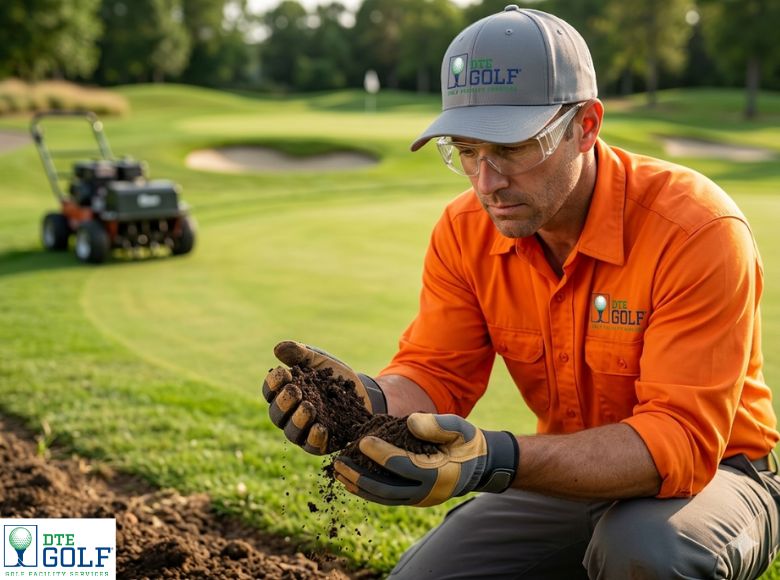
Soil health is the single most overlooked variable in golf course performance and the one with the greatest long-term impact on golf course grass quality, playing conditions, and operational costs. When the soil is healthy, everything else works better. When it is not, no surface-level fix can compensate.
What Soil Health Means for Golf Courses
Soil health is not simply about pH. It is a living system. A biologically active, structurally sound soil profile supports root depth, nutrient cycling, water retention, and drainage simultaneously.
For golf course turf specifically, healthy soil means:
- Deep root systems that access moisture and nutrients during stress events
- Efficient water movement that reduces disease pressure and localized dry spots
- Sustained nutrient availability that feeds turfgrass between applications, not just after them
- Natural resilience that helps turf recover faster from traffic, heat, and wear
Soil health should never be ignored.
According to the USGA, healthy soil structure and proper root-zone management are critical for maintaining consistent turf performance, drainage, and long-term golf course sustainability.
USGA Green Section – Turfgrass and Soil Management Resources
The Hidden Costs of Poor Soil Health on Golf Courses
Courses that skip systematic soil management do not save money. They simply defer costs and compound them over time.
Compacted soil reduces oxygen in the root zone, weakening turfgrass and making it more susceptible to disease.
Nutrient-depleted soil forces higher input volumes to achieve the same results. This drives up fertilizer costs year after year.
Poor drainage leads to anaerobic conditions that suppress beneficial microbial activity. These microorganisms are the engine that drives healthy turf growth.
The financial impact is measurable. Courses with chronically poor soil spend significantly more on reactive treatments such as fungicides, aerification recovery, overseeding, and replanting than courses that proactively invest in soil health as part of their golf turf management program.
Essential Soil Health Practices for Golf Course Maintenance
Practice | Purpose | Frequency |
Soil Testing | Identifies pH, nutrient levels, organic matter, and compaction issues | 1 to 2 times per year |
Core Aerification | Relieves compaction and improves gas exchange | Seasonally |
Topdressing | Smooths surfaces, dilutes thatch, and improves drainage | Monthly on greens |
Organic Matter Management | Supports microbial life and improves water retention | Ongoing |
Fertilization Based on Soil Data | Targets actual deficiencies and reduces waste | Based on test results |
The difference between courses that react to turf problems and those that prevent them almost always comes down to how consistently these five practices are executed.
The Relationship Between Soil Health and Turfgrass Performance
Even the strongest turfgrass varieties, such as Bermudagrass, Zoysia, and Paspalum, depend entirely on what the soil provides.
In Florida’s warm climate, where heat and humidity create constant biological stress, the soil must be actively managed to support golf course turf performance throughout the year.
Microbial populations in the soil break down organic matter and convert it into plant-available nutrients. Disrupt that ecosystem through excessive synthetic inputs or chronic compaction, and the turfgrass above will eventually show the effects.
Effective golf turf management does not start at the surface. It starts six inches underground.
How a Soil-First Golf Course Management Approach Works
At DTE Golf®, soil analysis is not a one-time checkbox. It is the diagnostic foundation of every agronomic program we build.
Before recommending a single input, our team evaluates current soil conditions, including structure, biology, and chemistry, and develops a fertility and management plan tailored to what the soil actually needs.
This approach results in fewer wasted inputs, faster turf recovery, more consistent playing conditions, and lower long-term maintenance costs.
Across the 800-plus holes we manage in Florida, it is the difference between courses that struggle through summer and those that emerge stronger on the other side.
Healthy soil is the foundation of every successful golf course. When soil health is prioritized, turf becomes stronger, recovery improves, maintenance becomes more efficient, and playing conditions remain consistent throughout the year.
Investing in soil health is not just about improving golf course grass today. It is about building long-term resilience, reducing operational costs, and creating a course that performs at a higher level season after season.
At DTE Golf®, we believe that sustainable golf turf management always starts beneath the surface, where the true strength of every course begins.
Frequently Asked Questions
Why is soil health important for golf course maintenance?
Healthy soil supports strong turf growth, improves drainage, reduces disease risk, and helps the course withstand heavy play and changing weather conditions.
How does healthy soil improve turf quality on golf courses?
Healthy soil provides better nutrient availability, root development, water retention, and airflow, resulting in denser, greener, and more resilient turf.
What are the common signs of poor soil health on a golf course?
Common signs include patchy grass, poor drainage, compacted soil, increased weed growth, weak root systems, and frequent turf diseases.
Which maintenance practices improve golf course soil health?
Practices such as aeration, proper irrigation, balanced fertilization, organic matter management, soil testing, and reducing compaction help improve soil health.
How does soil health support long-term golf course sustainability?
Healthy soil reduces the need for excessive water, fertilizers, and chemicals, lowers maintenance costs, and promotes environmentally responsible turf management.
Is Your Soil Working for You or Against You?
If your golf course grass is underperforming despite a solid maintenance routine, the problem is likely underground. Soil that has not been systematically managed accumulates problems quietly until they become unavoidable and expensive.
Build a Stronger Foundation for Long-Term Golf Course Performance with DTE Golf®
DTE Golf® specializes in soil-driven turfgrass management programs that diagnose what is actually happening beneath your turf and build the agronomic strategy needed to address it.
Contact DTE Golf® today to schedule your soil consultation and start building the kind of foundation that keeps your course performing at the highest level, season after season.