
Spring is the season superintendents wait for: the warming soil, longer days, and a growth window that can make or break a golf course’s condition report. Yet one practice still causes more member complaints than almost anything else on the maintenance calendar aerating greens.
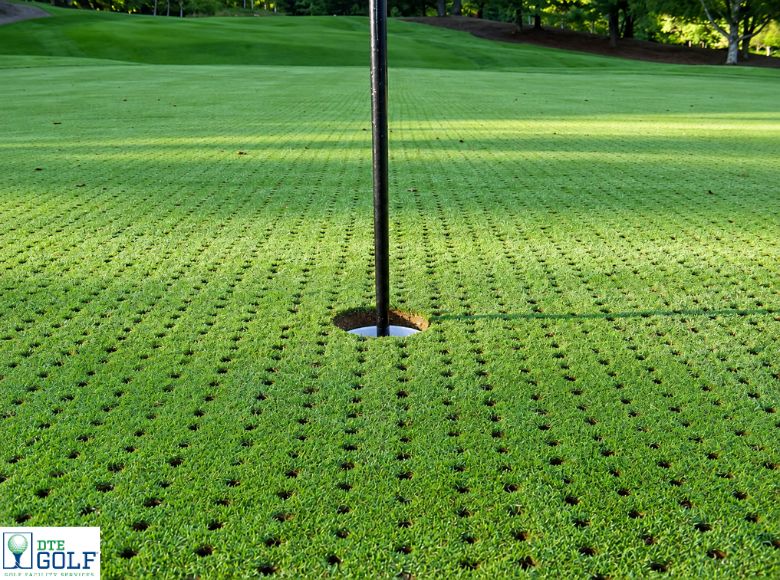
Golfers see holes in the putting surface and assume something has gone wrong. In reality, aerating greens in spring is one of the single most important investments a facility can make in long-term turf quality, playability, and revenue.
Key Takeaways
- Aerating greens relieves soil compaction and restores oxygen flow to turfgrass roots.
- Spring aeration timing aligns with peak turf growth potential for faster healing.
- Skipping or delaying aeration compounds thatch, drainage, and disease problems.
- Proper golf turf maintenance scheduling minimizes member disruption.
- A structured golf course maintenance program can support green recovery within 7 to 14 days, depending on conditions and aeration intensity.
- Professional golf consulting helps courses schedule aeration around tournaments and peak play.
What Are Aerating Greens?
Aerating greens is the mechanical process of pulling or punching small cores or holes into a putting surface to relieve compaction, remove excess thatch, and reopen channels for air, water, and nutrients to reach the root zone. Over a season of foot traffic, mower passes, and cart movement, soil beneath greens can become tightly compacted. This starves roots of oxygen and slows water infiltration. Without aerating greens on a consistent schedule, even a well-fertilized course can develop shallow roots, soft or spongy surfaces, and increased vulnerability to fungal disease.
Why Aerating Greens Matters for Spring Turf Recovery
Spring is the ideal biological window for aerating greens because turfgrass is entering its most active growth phase. Warming soil temperatures and increasing daylight mean the plant can heal aeration holes quickly, often within one to two weeks, with minimal disruption to play.
Courses that delay aeration into peak summer heat or push it into fall risk stressing turf when recovery is naturally slower, extending downtime and increasing the odds of secondary problems such as fungal outbreaks or weed encroachment.
For any facility serious about golf course maintenance, spring aerating greens is not optional. It is the foundation the rest of the season’s agronomic plan is built on.
The Data Behind Golf Turf Maintenance
Aeration Method | Best Season | Recovery Time | Primary Benefit |
Core (Hollow-Tine) Aeration | Spring | 10 to 14 days | Removes thatch, improves compaction |
Solid-Tine Aeration | Spring/Fall | 3 to 5 days | Low disruption, moderate compaction relief |
Deep-Tine Aeration | Late Spring | 7 to 10 days | Breaks up deep soil layers, boosts drainage |
DryJect (Air/Sand Injection) | Spring | 1 to 3 days | Minimal surface disruption, fast recovery |
Industry data consistently shows that courses aerating on a strict spring schedule report firmer, healthier greens through summer stress compared to those that aerate irregularly. This reinforces why golf course maintenance calendars should never treat aeration as flexible.
Industry Insight: A Central Florida Case Study
A daily-fee facility in Central Florida struggled for several seasons with soft, disease-prone greens by mid-summer. An agronomic review found the root cause was not fertility or irrigation. It was inconsistent aerating greens practices, with aeration pushed later each year to avoid disrupting member events.
Once the course committed to a strict spring aeration window paired with topdressing, root depth improved measurably within one growing season, and summer fungicide costs dropped as turf resilience increased. This pattern repeats across Florida golf course maintenance programs: courses with the most consistent aeration calendars consistently outperform those that treat it as negotiable.
Best Practices for Golf Course Maintenance Teams
- Schedule aerating greens when soil temperatures support active root growth.
- Pair aeration with topdressing to accelerate healing and firm surfaces.
- Communicate the aeration calendar to members well in advance.
- Rotate aeration methods, including core, solid-tine, and deep-tine methods, based on seasonal needs.
- Monitor soil moisture before aerating to avoid unnecessary turf stress.
Common Mistakes to Avoid
- Delaying aerating greens to avoid disrupting a single tournament.
- Using the same aeration method year-round regardless of soil condition.
- Skipping topdressing after core aeration, which can slow recovery.
- Aerating during heat stress instead of the optimal spring window.
Practical Checklist Before Aerating Greens
- Confirm soil temperature and growth potential.
- Schedule around the tournament and event calendar.
- Prepare topdressing sand and the fertilizer program.
- Notify members and update tee sheet communications.
- Inspect equipment, including tines and rollers, before the aeration window.
How Down To Earth Helps
Down To Earth has spent more than 30 years building agronomic programs for golf facilities across Florida and the Southeast, and aerating greens on the right calendar is central to that work. Rather than treating aeration as a disruptive necessity, Down To Earth’s superintendents build it into a full-season golf course maintenance plan, sequencing it with topdressing, fertility, and irrigation so greens recover faster and perform better through summer stress.
For facilities without in-house agronomic depth, this kind of golf consulting can be the difference between a green that limps through July and one that holds up under tournament pressure.
For a deeper technical look at aeration timing and turf physiology, the USGA Green Section resources offer helpful independent research that superintendents often reference alongside their own agronomic plans.
Final Thoughts
Aerating greens will never be popular with golfers, but it is a practice that can help separate courses with resilient, championship-quality surfaces from those constantly chasing turf problems. A disciplined spring aeration program, backed by the right golf consulting and golf course maintenance partner, sets the tone for the entire playing season.
FAQs
How does aerating greens improve root zone conditions and reduce spring turf stress?
Aeration relieves soil compaction, improves air and water movement, and creates channels that allow roots to access oxygen, moisture, and nutrients more effectively. By improving drainage and reducing thatch and organic matter buildup, aeration helps develop a healthier root system that can better withstand spring traffic, temperature changes, and disease pressure.
What is the ideal aeration frequency for golf greens based on turf species, soil conditions, and traffic levels?
Most golf greens benefit from two to four major aeration events per year, but the ideal frequency depends on turf species, soil type, compaction, organic matter accumulation, and traffic. Heavily trafficked greens or sites with compacted soils may require more frequent aeration, while well-drained greens with lower traffic may need less intensive intervention.
How should aeration practices be adjusted for Florida golf course maintenance and warm-season turf varieties?
Florida golf course maintenance requires aeration to be timed around active warm-season turf growth so greens can recover quickly from disruption. Bermudagrass and other warm-season varieties generally respond best when growing conditions support rapid recovery, while excessive aeration during periods of environmental stress should be avoided. Soil moisture, temperature, rainfall, and expected traffic should all influence timing and intensity.
What is the difference between core aeration, solid-tine aeration, and venting, and when should each method be used?
Core aeration removes plugs of soil and is the most effective option for reducing compaction and managing accumulated organic matter. Solid-tine aeration creates channels without removing soil and is useful when you need improved air and water movement with less surface disruption. Venting uses small, shallow openings to improve gas exchange and relieve minor compaction while maintaining better putting quality, making it useful between more intensive aeration events.
What post-aeration golf turf maintenance practices help greens recover faster while maintaining turf density and putting quality?
After aeration, proper irrigation, light fertilization, and appropriate topdressing help greens recover while supporting healthy root and shoot growth. Avoiding excessive traffic during recovery is equally important, while mowing should be carefully managed to prevent additional stress. Once the turf has sufficiently recovered, gradually returning to normal mowing, irrigation, and fertility practices helps restore smoothness and putting quality.
Keep Your Turf Ready to Perform. Act Today!
Protect turf health, improve recovery, and keep your course playing its best. Contact the DTE Golf® maintenance team today for a customized agronomic calendar built around your course’s climate, soil conditions, and play schedule.